

Educational objectives

This chair's objective is to provide a dedicated advanced training for engineers in the design of charged particle optic-based nano-characterization tools, such as mass spectrometers, electron or ion microscopes, and so forth. (see the introduction part of this site).
Advanced mechanics and optics courses, including analytical mechanics in the third year, hamiltonian optics in the fourth, and charged particle optics in particular in the fifth and final years, provide the necessary theoretically background to tackle charged particle optics.
These fundamental classes are supported by a modern practical platform for testing student-made electron or ion optics (see figure 1) and the development of new optics in collaboration with TESCAN to meet current industry challenges.
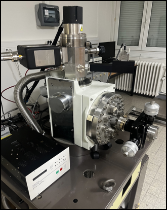
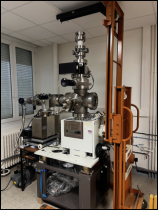
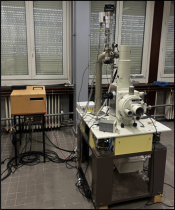
Figure 1 : (left) Ion optics test bench (center) Electron optics test bench (right) SEM with homemade beam control.
The educational objective is therefore two-fold :
- first to provide students with the physical language and mathematical tools necessary to study any design of modern characterization instruments.
- Then, in line with INSA's philosophy, these theoretical courses are always supported by practical works. These practicals enable students to safely confront the realities associated with these technologies (vacuum, high voltage, electronics, power supply control, etc.).
In order to accomplish such an objective, the fifth year teaching is centered around a project. The students who first follow charged particle optics lectures, will then have to design an unique optical system and evaluate it on one of the customized test bench developped in the Physics department. To achieve this goal, INSA is also gradually equipping the physics department with mechanical manufacturing tools, such as a 3D printer.
Each year, the optical system is selected by the professor, and students work as a team to build and test their new optics (see figure 2). They then compare their results with simulations obtained either using homemade Python programs or using the commercial SIMION software, for which INSA has purchased a license.
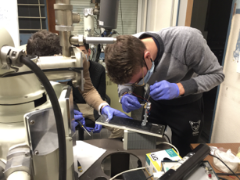
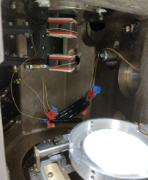
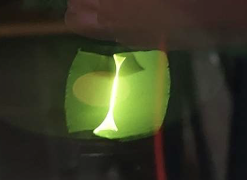
Figure 2 : Realisation of a quadrupoles doublet by students. Image of one quadrupole focalisation observed on a fluorescent screen inside the electron optics test bench.
The results are then presented to fourth-year students, followed by professors of the physics department and industrial collaborators during a poster session and talks (see for instance the page "some realisations by our students") .
Finally, we also offer a visit of the TESCAN company located in Aix-en-Provence. Since the start of this unique program in Europe, we have already trained five groups of students. Figure 3 shows group photos taken at TESCAN of the first promotion (2020-2021) and the most recent one (2025-2026).
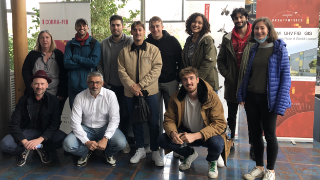
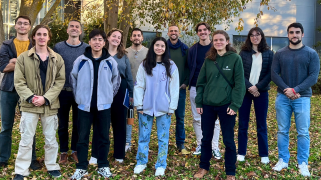
Figure 3 : Visit of TESCAN company (left) promo 2020-2021 (right) promo 2025-2026