

From light optics to charged particle optics : an historical introduction

Charged particle optics (CPO) is a science that compiles, under a common theoretical framework, all the laws governing the transport, focusing, mass/energy dispersion, etc. of charged particles, which may be electrons, positrons, ions or molecules. It describes the optical properties of all common individual optical elements (lenses, energy filters, magnetic sectors, etc.) and, thanks to the multiple combinations of these elements, enables the creation of a wide range of innovative instruments. For years, applications in this field have been considerable: the development of increasingly powerful electron microscopes, focused ion beams that have paved the way for nanomachining, secondary ion mass spectrometry (SIMS), an essential tool for characterising dopants in semiconductors, as well as large instruments such as synchrotrons and particle accelerators (see image 1).

Figure 1: Examples of systems using CPO. From left to right: focused ion beam (source: Orsayphysics), SIMS spectrometer (source: Cameca), synchrotron (electron storage line. Source: ALBA)
- A little bit of history
- From one image to another ...
A thousand years ago, the world witnessed a major revolution in the field of optics. The study of light by the Arab scholar Ibn al Haytham marked the birth of a revolutionary experimental approach with observation and analysis protocols, and the use of mathematics to formalise them. This revolution led to the awakening of science in Europe throughout the Middle Ages during the scholastic period until the Renaissance [1].
Hellenistic thought in antiquity was more interested in the phenomenon of vision than in the nature of light. Their theories could be roughly classified into three categories. The theories of extramission attributed to Euclid and the mathematical school of Alexandria, particularly Ptolemy, required visual rays to be emitted from the eye. Euclid established the laws of reflection, and his book ‘Optics and Catoptrics’ focuses on this concept of visual rays [2]. Theories of intromission, whose most prominent advocate was Aristotle, defend the presence of a potentially transparent medium, called the diaphanous, which becomes active through the action of light [3]. Finally, mixed approaches were also defended by Plato and Galen, and to a certain extent by Aristotle as well [4]. All these theories, which prevailed until the end of the first millennium AD, shared the fundamental principle that physical contact between the eye and the object is necessary for vision.
The fall of Rome in 476 and the advent of Islam were major social and political events that profoundly transformed knowledge and thought [5].
The rapid expansion of Islam, first under the Umayyad dynasty (661-750 in Damas) and then under the Abbasid dynasty (750-1258 in Baghdad), led to profound changes in the evolution of ideas. The Caliph Al-Ma'mūn (813-833) established one of the first scientific research centres in history in Baghdad, the famous Bayt al-Hikma (House of Wisdom) [6]. Intense intellectual activity prevailed with the translation, study and commentary of Greek, Persian, Indian and other texts. Hunayn Ibn Ishaq (808-873), a Nestorian Christian, trilingual (Arabic, Syriac and Greek) and an authority on the translation of Greek works, is one of the symbols of this period of translation. He also wrote the book ‘Ten Treatises on the Eye’ in the tradition of Galen [7]. At that time, major scholars contributed to the development of optics as a science: Al Kindi (801-873), Ibn Sīnā (980-1037), Ibn Sahl (940-1000) and, above all, Abu Ali al-Hassan ibn al-Hassan Ibn al Haytham (965-1040) with his major work Kitāb fī al-manāẓir (Book on Optics) [8].
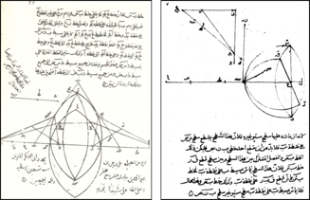
Figure 1: (left): The biconvex lens (right): and the plano-convex lens: extract from Ibn Sahl's treatise on burning instruments (Milli Library, Tehran) [9].
Ibn Sahl, in his book Kitāb al-ḥarrāqāt (Book on Burning Instruments) published in 984, contributed to the first mathematical description of the anaclastic properties of plano-convex and biconvex lenses (see Figure 1). This led him to discuss the refraction of light by a flat surface separating two media (see Figure 2). He thus formulated the law of sines five centuries before Willebord Snell and René Descartes [9].
The sciences of Islamic countries spread to the Latin world from the 10th century onwards, thanks to travellers, Jewish communities settled in both worlds, direct contacts, and the reconquest of Sicily (1063) and Toledo (1085). Numerous translations were made from the 12th century onwards. At Oxford, Robert Grosseteste (1253) positioned himself as the heir to both Aristotle and the physicists of the islamic world. Grosseteste developped a metaphysics of light and applied it to the natural sciences where he identified the lux as the light of creation starting from a point and expanding to the limit of a fundamental sphere limiting our unverse. From this sphere the material light (the lumen) then retracts back to the center point and so on. He treats lumen as vibrations analogous to the sounds that propagate in the ether; he applied a geometrisation using spheres, straight lines and measurements to explain reflections and refractions. This is the first wave conception of light. These studies were continued by Roger Bacon (1253), John Peckam (1253), Witelo (1253) and Theodoric of Freiberg (1311) who, at the same time as Kamal al-din al-Farisi in the islamic world, explains the formation of rainbow (see figure 2) [10].
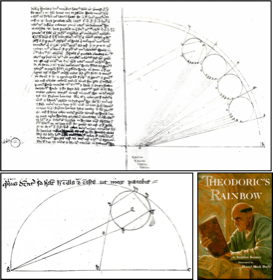
Figure 2 : Formation of the rainbow by the Dominican Thierry de Freiberg[10]
[1] Imbert, M. La fin du regard éclairant. 2020. Vrin Mathesis.
[2] Lejeune, A. Euclide et Plolémée. Deux stades de l'optique géométrique grecque.1948. Bibliothèque de l'Université de Louvain.
[3] Vasiliu, A. Du diaphane : image, milieu, lumière dans la pensée antique et médiévale. 1997. Vrin - Études de philosophie médiévale.
[4] Merker, A.. La vision chez Platon et Aristote. 2003. Academia Verlag - International Plato Studies.
[5] Djebbar, A. Une histoire de la science arabe. 2001. Points.
[6] Touati, H. Bayt al-hikma : la Maison de la sagesse des Abbassides, in Houari Touati (éd.), Encyclopédie de l’humanisme méditerranéen, 2014 (http://www.encyclopedie-humanisme.com/?Bayt-al-hikma).
[7] Russell, G.A. Histoire des sciences arabes, tome 2: Mathématiques et Physique. 1997. dirigé par R. Rashed. Seuil.
[8] Rashed, R.. Ibn al-Haytham L'émergence de la modernité classique. 2021. Hermann Philosophie, Politique et Économie - Sciences et Technique.
[9] Rashed, R.. Géométrie et dioptrique au xe siècle: Ibn Sahl, al-Qūhī, et Ibn al-Haytham. 1993. Collection Sciences et Philosophie Arabes, Textes et Études. Les Belles Lettres.
[10] Kramer, S.P. Theodoric’s rainbow. 1995. Scientific American Books for Young Readers, New York.
- Geometrical optics
The history of geometrical optics in the years that followed is one of a quest for mathematical precision and perfection in instruments. It all really began with Pierre de Fermat (1665), who in 1662 stated his famous ‘principle of least time’. This principle allowed to describe the light trajectory under a single elegant mathematical rule. He ultimately rejected his theorem in order to avoid problems with the Cartesians, who supported Descartes' theory of refraction, whose conclusions regarding the speed of light in materials were opposed to his own [1].
Then came William Rowan Hamilton (1865) ... Before Hamilton, optics was treated as a series of isolated geometric problems. Hamilton revolutionised the field by introducing the characteristic function. He demonstrated that all optics could be deduced from this single mathematical function in the spirit of the Fermat's principle [2]. His approach made it possible to treat light not only as rays, but as a wavefront, building a crucial bridge between geometric optics and wave optics [3].
Also in the course of the 19th century, Carl Friedrich Gauss (1855) laid the foundations of modern optics by developing the approximation that bears his name. By focusing on rays close to the optical axis (paraxial rays), he linearized the calculations of the Hamilton's characteristic function and defined the fundamental concepts of focal points, principal planes and focal length [4].
The Gaussian approximation worked well for very thin lenses, but reality is more complex. Philipp Ludwig von Seidel (1896) was the first to mathematically analyse deviations from paraxial rays: these are known as Seidel's five aberrations (spherical, coma, astigmatism, field curvature, distorsion) [5].
The work of Ernst Abbe (1905) marked the transition from traditional optics to modern scientific optics at the end of the 19th century. He revolutionised instrument design at Zeiss company [6]. Working in collaboration with glassmaker Otto Schott (1935), E. Abbe was able to design new kinds of optical systems, such as apochromatic lenses. Indeed, he succeeded using such a design to correct chromatic aberrations for three colours simultaneously (instead of two for older achromatic systems). He understood that to obtain perfect images at high magnifications (particularly in microscopy), it was not enough to simply reduce chromatic aberrations. In 1873, he formulated the sine condition, which defines the geometric relationship necessary for an optical system to form a sharp image, even with rays deviating significantly from the axis. A system that complies with this rule is called aplanatic : it is free from spherical aberration and coma for objects close to the axis, ensuring crystal-clear sharpness from the centre to the edges of the image [7]. Abbe also revolutionised microscopy by demonstrating that the image of a very small object is not a simple geometric reproduction, but the result of a diffraction phenomenon [8].
Shortly after Abbe's work, Schwarzschild took the analysis even further. He extended Seidel's theory of aberrations to include more complex systems, such as mirror telescopes. He introduced a calculation method using perturbation theory, that allows for the design of very high-precision optical systems [9]. His work made it possible to correct higher-order aberrations, paving the way for the design of large modern astronomical telescopes.
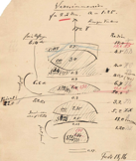
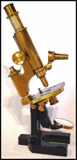

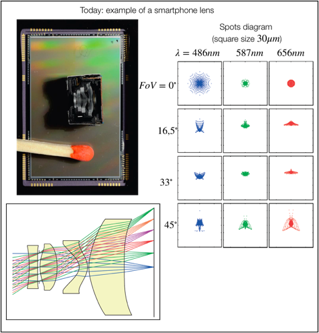
Figure 3: (top) Concept and subsequent creation of a corrected optical microscope by Ernst Abbe (photo). (bottom) Design of modern optics for smartphones [12].
Modern optical system design is now carried out using powerful software such as OSLO or Zeemax [10, 11], but still follows the methods based on Hamiltonian optics and used in the past by pioneers such as Abbe (see figure 3 for an ewample of lens optimization for smartphone optics).
[1] Fermat, P. Oeuvres de fermat. 2013 Hachette BNF.
[2] Hamilton, W. R. On a general method of expressing the paths of light, and of the planets, by the coefficients of a characteristic function. Dublin University Review and Quarterly Magazine 1, 1833, 795–826 .
[3] Hamilton, W. R. Theory of Systems of Rays. The Transactions of the Royal Irish Academy 15, 1828, 69–174.
[4] Gauss, C. F. Dioptrische Untersuchungen. 1877 in Werke 243–276 Springer.
[5] Seidel, L. Über die Entwicklung der Glieder 3ter Ordnung welche den Weg eines ausserhalb der Ebene der Axe gelegene Lichtstrahles durch ein System brechender Medien bestimmen. Astronomische Nachrichten, 1856, 43, 289.
[6] Auerbach, F. Zeiss Works and the Carl-ZEISS Stiftung in Jena. 2022, LEGARE STREET PRESS, S.l.
[7] Abbe, E. Beiträge zur Theorie des Mikroskops und der mikroskopischen Wahrnehmung. 1873. Archiv f. mikrosk. Anatomie 9, 413–468.
[8] Volkmann, H. Ernst Abbe and His Work. 1966. Applied Optics, Vol. 5, Issue 11, pp. 1720-1731.
[9] Schwarzschild, K. Untersuchungen zur geometrischen Optik. 1905 Astronomische Mitteilungen der Universitaets-Sternwarte zu Goettingen 9, 1.
[10] Savage, N. Optical design software. 2007. Nature Photon 1, 598–599 .
[11] Moore, K. E. ZEMAX: software for optical design, analysis, and optimization. 1992. Proc. SPIE 1752, 284–293.
[12] Gross. H. (Editor) Handbook of Optical Systems: Volumes 1 to 6 (Wiley, 2005). doi:10.1002/9783527699223.
- Photonic optics vs charged particle optics
At the end of 19th century, new mysterious rays were observed escaping from the cathode of Crookes and Hittorf's vacuum tubes [1]. In 1897, Joseph John Thomson (1940) demonstrated that these rays were composed of negatively charged particles: electrons. This marked the birth of charged particles optics, as it was realised that these particles could be deflected by electric and magnetic fields [2].
The real conceptual leap forward came with Hans Busch (1973). He demonstrated mathematically that an axially symmetric magnetic field procued by a coil acts on a beam of electrons in exactly the same way as a glass lens acts on light. He proved that the trajectories of electrons obey the same laws of focusing as classical geometric optics [3]. Louis de Broglie's hypothesis associates a wavelength with every massive particle [4]. This allows Abbe's theory to be applied to electrons and other new charged particles discovered in the beginning of the 20th century. Since the wavelength of a fast electron is much shorter than that of light, Abbe's theory of imaging predict that an ‘electron microscope’ could see in the nanometric world. Ernst Ruska and Max Knoll built the first prototype transmission electron microscope (TEM) in Berlin [5]. Using two magnetic lenses in series, they succeeded in obtaining a magnified image of a metal grid. In 1933, they exceeded the resolution of the optical microscope for the first time, confirming the power of this new optical system.
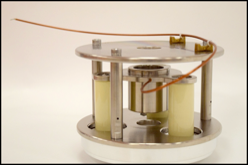
Figure 4 : Einzel electrostatic lens.
The parallel between photonic optics and the optics of charged particles (electrons, ions) is one of the most elegant analogies in physics. It is based on the fact that, despite their different physical natures, both systems obey identical mathematical formalism ground in the Hamiltonian picture of physics (see figure 5) [6].
Hamilton understood that the trajectory of a ray of light and that of a massive particle both follow a ‘principle of economy’. With light, the Fermat's principle is expressed through the refractive index n. In a similar manner, Maupertuis' principle states that a massive particle follows the path of minimum action. Here, it is the momentum of the particle that plays the role of the refractive index. There is then a mathematical equivalence which has deep consequences. Indeed, we can say that the ‘effective’ refractive index for a charged particle in an electric potential V is simply proportional to n∝√V [7]. Figure 4 shows a photograph of a simple arrangement of three electrodes forming a standard electrostatic lens called an Einzel lens (which means "simple lens" in German).
Because both systems are governed by the same geometric laws, they share the same defects. The work of Seidel and Abbe applies almost unchanged to instruments based on charged particles optics [8].
Like for light optics, design of charged particle optics instruments uses Schwarzschild methods to calculate off-axis trajectories. In electron optics for instance, this makes it possible to design ‘aberration correctors’ using multipoles that act as corrective lenses for the world's most powerful microscopes [9].
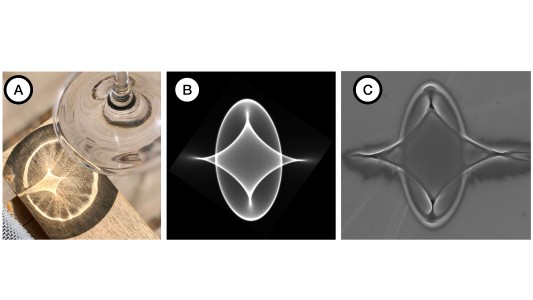
Figure 5 : Caustics observed with a-light beam b-electrons beam and c-ions beam [6]
[1] Goldstein, E. Vorläufige Mittheilungen über elektrische Entladungen in verdünnten Gasen. 1876. Annalen der Physik 235, 633–657.
[2] Thomson, J. J. XL. Cathode Rays. The London, Edinburgh, and Dublin Philosophical Magazine and Journal of Science. 1897. 44, 293–316.
[3] Busch, H. Berechnung der Bahn von Kathodenstrahlen im axialsymmetrischen elektromagnetischen Felde. 1926. Annalen der Physik 386, 974–993.
[4] De Broglie, L. Recherches sur la théorie des Quanta. Ann. Phys. 1925. 10, 22–128.
[5] Knoll, M. & Ruska, E. Das Elektronenmikroskop. Z. Physik. 1932. 78, 318–339.
[6] Fraysse, T., Cours, R., Lourenço-Martins, H. & Houdellier, F. Morphologies of caustics studied by catastrophe charged-particle optics. 2026. Ultramicroscopy 282, 114291.
[7] Rose, H. H. Geometrical Charged-Particle Optics. 2009. Springer, Berlin.
[8] Hawkes, P. W. & Kasper, E. Principles of Electron Optics. Volume 1: Basic Geometrical Optics. 2018. Elsevier, London.
[9] Haider, M. et al. A spherical-aberration-corrected 200kV transmission electron microscope. 1998. Ultramicroscopy 75, 53–60.