

Scientific objectives

As part of this chair, and in collaboration with TESCAN engineers, INSA, CNRS colleagues, and our students as part of their training, we would like to start an activity centered on the design of novel optical elements for use in future instruments like FIBs .
As already mentioned in section dedicated to the educational objectives, the physics department at INSA Toulouse takes a very practical approach to teaching physics. It is with this vision in mind that multidisciplinary projects are offered to fourth-year students every year. Throughout the year, students are given dedicated time during which they are expected to set up and solve specific problems provided either by industrials from different fields of physics or by academics from the region. To help and guide them properly, they are supervised by professors of the physics department and/or scientists working in public laboratory or private companies who are specialists in the field and partner of the department.
Within the chair, we therefore aim to offer at least two multidisciplinary projects each year specifically on new developments in charged particle optics in connection with current developments performed TESCAN.
In addition, INSA has recently introduced specific training programs called "research courses" or "parcours recherche" in french, offered in the fourth and fifth years, dealing with more fundamental topics than a classical multidisciplinary project. This program is proposed to students who are looking for a research experience. The chair could therefore be a source of many topics, both in optical design and more theoretical subjects such as simulation, Hamiltonian optics, etc. We already have supervised many multidisciplinary projects and we have actually one research course working on the simulation of trajectories in SEM (Scanning Electron Microscopy). Another one will start next academic 2026-2027 period on catastrophe charged particle optics and will be supervised with a colleague from CNRS.
In addition, the scientific activity may offer master 1 and marter 2 internships for students interested in continuing these developments.
- Overview of some relevant scientific topics tackled within the chair
This activity will be carried out technically on the dual beam loan by TESCAN (see the page partnership with Tescan). CAD modelling and calculations of electromagnetic fields and optical properties will be carried out using the software used at INSA for teaching purposes (SIMION, FEM (COMSOL), BEM (BEMPP package) using Python).
We briefly describe below three ongoing activities :
- Measurement of ion optics aberrations using catastrophe charged particle optics
One master student already worked on this topic (see paper [1]). A "research course" will start next academic 2026-2027 year.
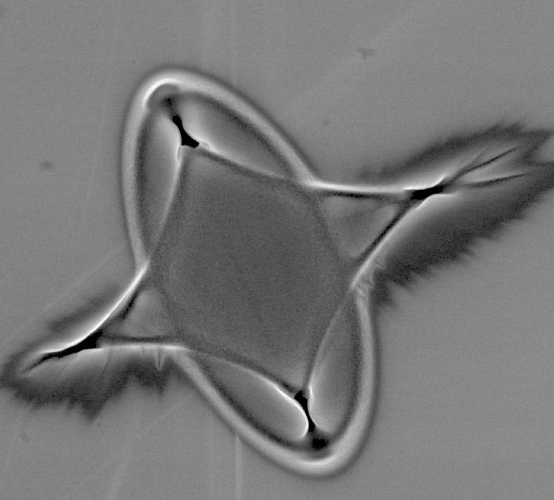
Figure 1 : Caustic formed by an ion beam with spherical aberration and two-fold axial astigmatism [1].
[1] Fraysse, T., Cours, R., Lourenço-Martins, H. & Houdellier, F. Morphologies of caustics studied by catastrophe charged-particle optics. 2026. Ultramicroscopy 282, 114291.
- Design of electrostatic optics
Design of new optical systems using electrostatic fields only. Working on electrodes shapes, positions and symmetries.
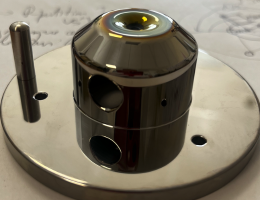
Figure 2 : Single electrode design for use in Einzel electrostatic lens
- Calculation of fields, paraxial and aberrations in charged particle optics systems. Towards the optimisation of optical systems.
This is currently the most popular activity, as it will feed into the others once it is well advanced. We have already worked on two multidisciplinary projects and a research programme is currently underway. Below we show a result obtained by our students.
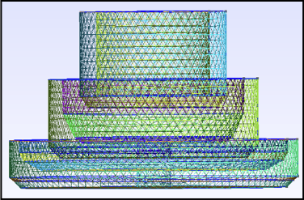
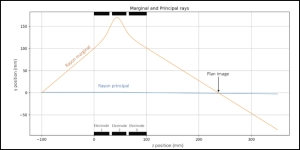
Figure 3 : BEM simulation of an Einzel lens (see introduction page) and paraxial trajectories computed using homemade python software (Students : Niels Brun and Paul Besnard)
We would also like to promote this scientific activity by organising workshops and conferences dedicated to charged particle optics on the site of the physics department, bringing together players in the field who wish to develop also an activity around new optics.